Before the first freeze: a winter checklist for a condo building's common areas
What to check in a condo building's common areas before winter, zone by zone: roof, envelope, heating, garage, outside water, generator and entrances.
By Condo Inspection Team
Most of the winter damage in a condo building is decided in October. A roof drain choked with leaves, an outside faucet nobody shut off, a garage ramp heater whose breaker was switched off in May: none of them costs anything until the first hard freeze, and then each one costs a lot at once.
This checklist is for the walk-through to do before that freeze, in a building in Canada or the northern United States. It is the same for an HOA or condo association and for a condo corporation or strata. It is organized by zone, in the order you would walk the building, and for each item it says what to look at, what to photograph, and who should do it.
Three notes before you start.
It does not replace the inspections your systems already need. Fire alarms, sprinklers, elevators, boilers and generators have their own inspection and testing schedules, set by the codes and authorities where you are, and your contractors should already be following them. The walk-through confirms that the work was done. It does not redo it.
Photograph from the same spot every year. A photo of a crack is useful once next year's photo of the same crack can sit beside it. Note where you stood: a column number, a parking space, a unit number above.
Know who does what. "Staff" below means the building's superintendent or maintenance team. In a self-managed building, a board member often does that part, which is fine for looking and photographing. Anything on a roof or a ladder, or inside a boiler, an electrical panel or a sprinkler valve, is a contractor's job.
Before you walk: the paperwork
- The contact list. Heating contractor, plumber, electrician, roofer, sprinkler contractor, generator service, elevator company, snow removal: a name and an after-hours number for each, posted in the mechanical room and on the phones of the people who will need it at 3 a.m.
- The service reports. The dates of the last boiler service, generator test, sprinkler inspection and garage gas detection calibration. A report you do not have is a call to make now, not in January.
- Last year's notes and photos, if there are any.
Who: the manager, or a board member in a self-managed building.
Roof and drains
Water that cannot leave a flat roof freezes around the drain, and the next thaw has nowhere to go but through the membrane.
- Drains and scuppers. The strainer, the dome over the drain, is in place and fastened. No leaves, gravel or debris around it, and no sign of ponding. Photograph each drain. Clear them after the last leaves have fallen, not before.
- Heat tracing. If drains, gutters or downspouts have heating cables, turn them on and confirm they heat: an indicator light, a reading at the panel, or warmth by hand. Look for cables that have come loose or been crushed.
- Membrane and flashing. Blisters, open seams, punctures, flashing pulled away at the parapets and around anything that goes through the roof (vents, the curbs of rooftop units). Photograph anything that looks different from last year.
- Rooftop equipment. Access panels on rooftop units and exhaust fans closed and fastened, nothing loose that the wind can lift.
- Gutters and downspouts, on low-rise and townhouse buildings. Clean, joints sealed, and each downspout discharging away from the foundation, not onto a walkway where the water will freeze.
- Access. The roof hatch closes and seals and the ladder is secure. Agree now on who goes up in winter, and with what fall protection.
Who: staff or the roofer for the walk-through. The roofer for any repair, and an electrician for heat tracing that stays cold. A board member should not be on the roof in November.
Envelope and caulking
Water that gets into a crack in the fall freezes, expands and widens it. The freeze-thaw cycles do their damage over the winter, so the point now is to find the openings before they start.
- Sealant joints around windows and doors, at balcony door thresholds and at expansion joints: cracked, shrunken, pulled away on one side, or missing. Photograph a few typical joints on each side of the building, and every one that is failing.
- Masonry and cladding. Cracks, spalled brick or concrete, open mortar joints, loose panels, and white deposits on the surface (efflorescence), which mean water is moving through the wall. Photograph with something in the frame for scale. Binoculars cover the upper floors from the ground.
- Common doors. Weatherstripping intact on the main entrance, the garage service doors and the roof hatch, and every door latching when it closes. Hydraulic door closers slow down in the cold, and a door that stops short lets in the cold and anyone who wants in.
- Vents at ground level. Dryer and exhaust vent flaps move freely. On townhouses, the intake and exhaust pipes of high-efficiency furnaces and water heaters are often low on the wall: someone has to keep them clear of snow, because a blocked exhaust from a fuel-burning appliance is a carbon monoxide risk.
- Foundation and grading. The ground slopes away from the walls, and window wells are clean and covered.
Who: staff, walking around the building. A masonry contractor or a building envelope consultant for anything out of reach, or anything that is worse than last year.
Heating plant
The heating contractor's pre-season service is the main event. The walk-through confirms it happened and covers what surrounds it.
- The service report. The boiler, furnace or heat pump service for this season is done, and the report is on file. If not, that is the first call.
- The boiler room. Nothing stored against the boiler or near the burners. Combustion air openings are open: people block them in winter because they let cold air in, and the burner is left short of air. Floor drains are clear.
- Gauges and leaks. Pressure and temperature within the range the contractor gave you, and no drips at pumps, valves or the expansion tank. Photograph the gauges, because next month's reading means something only if you have this one.
- Glycol loops. Where a heating loop runs through a cold space, such as garage heaters or the coil of the make-up air unit, the contractor checks the antifreeze concentration.
- Make-up air unit. Filters changed, burner serviced, and the freeze protection on the coil working.
- The cold corners. The sprinkler valve room, the water entry room, the stairwells and vestibules next to exterior doors, the garbage room, the electrical rooms. Each has a heater that works and a thermostat that nobody has turned down. If the building has low-temperature alarms, test one and make sure the alarm reaches someone who answers.
Who: the heating contractor for the service. Staff for the room, the gauges and the cold corners.
Garage
An underground garage takes in everything the cars bring in winter: snow, slush, salt and sand. It also tends to hold the building's longest runs of pipe in unheated space.
- Ramp heating. If the ramp is heated, switch it on and confirm it heats before the first snow, along with the breaker and the snow sensor, if there is one. A system switched off for the summer is easy to find still off in the first storm.
- Carbon monoxide detection and exhaust. The gas detection that starts the exhaust fans is in service and calibrated on the schedule its manufacturer sets. Doors stay closed more in winter and cars idle to warm up, so this is the season it matters. Confirm the date of the last calibration, and that the fans start when the system calls for them.
- Drains, trench drains and the oil separator. Clear of sediment before the salt season starts. Sump pumps start when the float rises. Photograph each pit with its pump.
- Sprinklers. In an unheated garage the sprinkler system is often a dry system, with air in the pipes rather than water. Its low points collect condensation, which can freeze and split the pipe, so the sprinkler contractor drains them before freezing weather and again as needed through the winter. Wet sprinkler pipe in a cold space needs heat. Ask the contractor which kind you have and when they were last here.
- The overhead door. It opens and closes fully, stops and reverses when it meets an obstacle, and its weatherstripping is intact. If it has a close timer, it is set. A garage door left open through a cold snap is how pipes freeze.
- The slab. Cracks, spalling, exposed or rusting rebar, and leaks through the ceiling with white deposits around them. Salt speeds up all of it. Photograph each spot with a reference, a column number or a parking space, so it can be found again in April.
Who: staff for the walk-through. The contractors who maintain the gas detection, the sprinklers and the door for their systems, and a structural engineer if the slab has changed since last year.
Outside water
- Outside faucets (hose bibs). Close the shutoff valve inside, open the outside faucet to drain it, and leave it open. Disconnect every hose, including from frost-free faucets: a hose left on holds water in the faucet and defeats the design. Tag the inside valves so nobody reopens them in January.
- Irrigation. The irrigation or landscaping contractor blows the lines out with compressed air and drains the backflow preventer. If your municipality requires backflow testing, it has its own schedule; confirm it is done.
- Fountains, pools and outdoor showers. Closed and drained.
- Pipes near the outside. Water lines in unheated spaces or along exterior walls (garage, crawl space, entrance vestibule) have their insulation and heat tracing in place.
Who: staff for the faucets and the pipes, the irrigation contractor for the irrigation.
Generator
If the building has an emergency generator, its testing routine is set by the codes and standards that apply where you are, and the service contractor follows it. Before winter, check what surrounds it.
- The last test. The report for the most recent test and service is on file.
- Fuel. The tank level, the delivery arrangement, and when the fuel was last checked for water, which collects in diesel that sits.
- Cold starts. The engine block heater works (the engine should be warm to the touch), and the battery and its charger are in good condition.
- Air and exhaust. Louvres and the exhaust outlet are where drifts will not block them. If the generator is outside, the path to it is part of the snow contract.
- What it powers. Find out exactly which circuits the generator feeds before the first outage: often emergency lighting and the life-safety systems, sometimes an elevator or the sump pumps. Residents tend to assume it powers more than it does, so tell them what will and will not work.
Who: the generator contractor for tests and service. Staff for the fuel level and the walk-around.
Entrances and walkways
- Lighting. Every exterior light and parking light works, photocells are clean, and timers are reset when the clocks go back, on the first Sunday of November in most of Canada and the US. Days are short, and a fall on an unlit step is the claim nobody wants.
- Steps, ramps and handrails. Handrails solid, treads firm, no heaved slabs that will catch a shovel or a foot.
- Where the water lands. Look for downspouts, roof edges and drips that drop water on a walkway. Each one becomes an ice patch. Move it now, or plan to salt that spot every day.
- Mats. Entrance mats for the salt and slush season, and a spare set.
- Snow storage. Decide where the piles go, so that they never cover a hydrant, the fire department connection, a catch basin, an emergency exit or the view at the driveway exit, and never melt back toward the building. Mark it on a site plan for the contractor.
- Emergency exits. A door that opens outward needs the snow cleared on the outside, every time.
- De-icer. A supply on site before the first storm, and an agreement on which product goes where. Rock salt is hard on concrete, including the garage slab it gets carried into, which is why some buildings use a gentler product on steps and near entrances.
Who: staff, with the snow contractor for the storage plan.
Vacant units and empty rooms
- Units empty for the winter. The association should know which owners are away, when they come back, and who to call while they are gone. The heat should stay on at a safe minimum, and ideally the water is shut off at the unit's valve. What your declaration or bylaws say about entering a unit in an emergency is worth knowing before the emergency. Owners should read their own insurance policy: many put conditions on freezing damage when a home is left unheated or unchecked.
- Rooms nobody uses in winter. Guest suite, party room, pool room, storage rooms: thermostats not turned down to nothing, windows shut, no pipes along cold walls without heat.
- Units under renovation. Contractors leave windows open and turn the heat off. A reminder to owners with work underway costs nothing.
Who: the manager or the board for the list of absent owners and their contacts. Staff for the empty rooms.
The snow contract
Slip-and-fall claims are where an unclear snow contract costs the most. Read it now, while you can still change it, and check that it answers these questions:
- Start and end dates. If it snows before the start date, are you covered, and at what price?
- Trigger depth. The accumulation that sends the contractor out: 2 cm, 5 cm, an inch, two inches. Whatever it is, it should be written down, and be the same number for you and for the contractor. Is there a separate trigger for salting when there is ice but no snow?
- What is covered. Driveway, parking, walkways, steps, emergency exits, hydrants and the fire department connection, the garbage enclosure, the mailboxes, the path to an outdoor generator. When the piles get too big, is the snow hauled away or only pushed back, and is hauling extra?
- Salt and abrasives. Which product, where, how often, whether it is included or billed per application, and who does the steps and entrances: the contractor or the building's staff.
- Timing. How soon after a snowfall the contractor arrives, whether they come during a long storm or only after it, and what is cleared first. Exits and fire routes should be.
- Who calls whom. The dispatcher's number, day and night, and a named contact. On the association's side, one or two people make that call, not every resident.
- Records and insurance. A log of each visit with the time and what was done, and a current certificate of insurance. After a fall, what helps is a record of when that walkway was last cleared and salted.
If the contract is recorded in Condo Inspection with its end date and cancellation deadline, the reminders come before both, so the renewal is a decision instead of something that happened. The asset registry page covers service contracts.
Make it repeat
A checklist done once makes for a good October. Done every year, it becomes the building's history: which joint was failing three winters ago, when the garage slab started to spall, whether the ice patch by the side door came back after the downspout was moved. It is also the condition data the next reserve study, or reserve fund study, or depreciation report, needs.
That works only if next year's walk-through follows the same list, and this year's photos can be found. A few habits make the difference:
- Keep the list in one place, not in one person's head, and add what this winter teaches you on the day it happens.
- Photograph the same things from the same spots, and file the photos with the component they show, not by date in someone's phone.
- Put next year's walk-through in the calendar now, for the same weeks, assigned to a person rather than to "someone".
- When an item cannot be done, write down why. "Roof not inspected: ice on the hatch" is a record. A blank line is a gap.
In Condo Inspection, those habits are how the app already works:
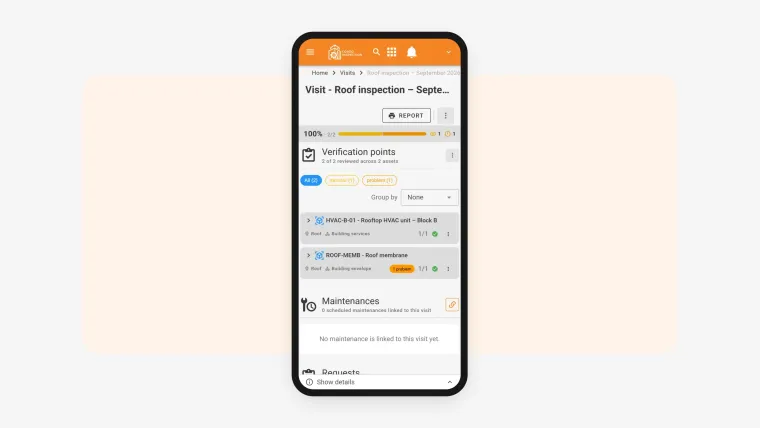
- The items to verify are set once on each asset category, roof drains or boilers or garage doors, and every inspection of that type follows the same list. Two people a year apart check the same points.
- Photos and video attach to the visit or to the asset itself, and an image can be annotated to point at the crack.
- A visit downloaded in advance works with no signal in the garage or the mechanical room, and syncs when the connection comes back.
- The pre-winter inspection can repeat every year on its own, assigned to a person or a team, and the dashboard shows it when it is late.
- When an inspection is canceled or postponed, the reason stays in the history.
- The things you notice on the way, a light out or a drain backing up, go into a quick visit, four questions and done, and the repair is tracked as an intervention, separate from the inspection.
The inspections page covers verification points and recurring inspections, and the scheduling page covers the calendar, assignments and reminders. Or book a demo and bring this list.