Florida condos and the December 31, 2026 SIRS limit: what to do with the study once you have it
For Florida condos existing on July 1, 2022, December 31, 2026 is the last date for a first SIRS. What the law asks once it arrives, and how to keep it useful.
By Condo Inspection Team
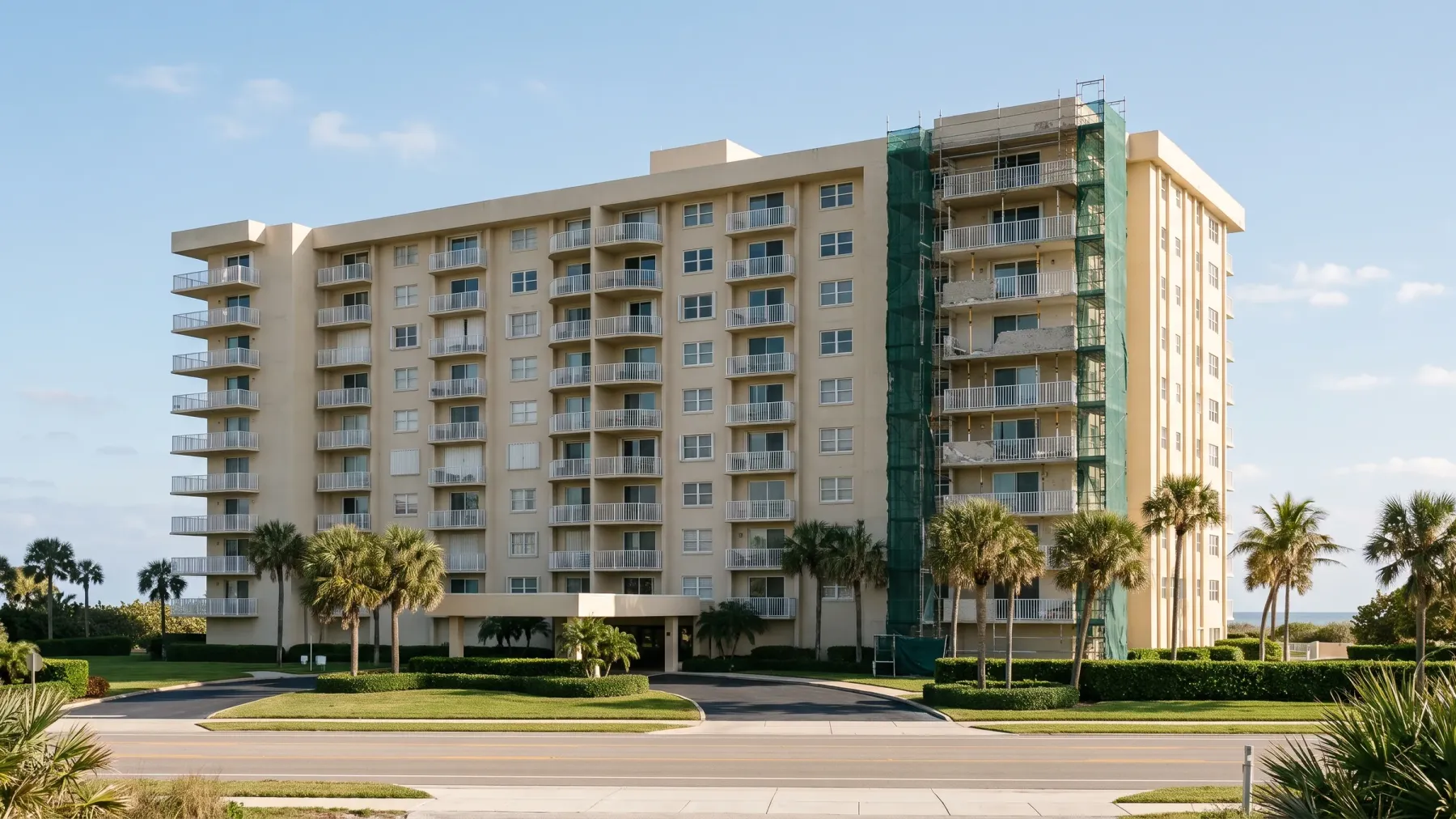
Florida's condominium laws, rewritten since 2022, require two documents for each building of three habitable stories or more: a milestone inspection of its structure, and a structural integrity reserve study (SIRS) that sets what the association must save to keep it sound. For owner-controlled associations that existed on July 1, 2022, the first study was due by December 31, 2025, and the law allows none to be completed after December 31, 2026.
Most of what has been written about the SIRS is about getting one. This article is about what comes after: the 45 days that follow its delivery, the budgets that have to follow it, and the ten years until the next study, when someone will ask what the association did with the first one.
It is written for the boards and managers of Florida condo associations. In Canada the nearest equivalents are a reserve fund study and, in British Columbia, a depreciation report, and most of the second half applies to them as well.
What the law requires, in short
The rules are in the Florida Statutes linked at the end of this article. They have been amended every year since 2022, and your association's attorney is the person to read them against your declaration. In short:
The structural integrity reserve study
- Which buildings. Each building on the condominium property that is three habitable stories or higher, as determined by the Florida Building Code. Single-family to four-family dwellings with three or fewer habitable stories above ground are among the exclusions (s. 718.112(2)(g)1. and 5.).
- What it covers. As they relate to the structural integrity and safety of the building: the roof; the structure, including load-bearing walls; fireproofing and fire protection systems; plumbing; electrical systems; waterproofing and exterior painting; windows and exterior doors; and any other item whose deferred maintenance or replacement would cost more than $25,000 (or the inflation-adjusted figure set by the Division of Florida Condominiums, Timeshares, and Mobile Homes, part of the Department of Business and Professional Regulation, if higher) and whose failure would affect those items. It leaves out any portion or component of the building maintained by a party other than the association, such as one the declaration leaves to the unit owners (s. 718.112(2)(g)1. and 5.).
- Who does it. It is based on a visual inspection, performed or verified by a licensed engineer or architect, or by a reserve specialist or professional reserve analyst certified by the Community Associations Institute or the Association of Professional Reserve Analysts (s. 718.112(2)(g)2. and 3.). A milestone inspection performed within the past five years that meets the same requirements can take the place of the visual inspection (s. 718.112(2)(g)8.).
- What it gives you. For each item inspected, its estimated remaining useful life and its estimated replacement cost or deferred maintenance expense, and a reserve funding plan with a recommended annual amount. At a minimum that includes a baseline funding plan, one that keeps the reserve cash balance above zero every budget year (s. 718.112(2)(g)4.a.).
- How often. At least every 10 years (s. 718.112(2)(g)1.).
- The first deadline. Associations that existed on or before July 1, 2022 and are controlled by unit owners rather than the developer had to complete it by December 31, 2025. An association that must complete a milestone inspection on or before December 31, 2026 may do the study at the same time, and "in no event may the structural integrity reserve study be completed after December 31, 2026" (s. 718.112(2)(g)7.).
A separate provision lets an association that completes a milestone inspection delay a required study for up to two budget years, so the money can go to the inspection's repairs first (s. 718.112(2)(g)9.). The statute does not say how that delay fits with the December 31, 2026 limit; an association relying on it should ask its attorney.
Willfully and knowingly failing to complete the study is a breach of the officers' and directors' fiduciary relationship to the unit owners (s. 718.112(2)(g)10.).
The reserves that follow it
- In an association that must have a SIRS, reserves are kept for the study's items that the association is responsible for under the declaration, based on the findings and recommendations of the most recent study. For an item whose useful life cannot readily be estimated, or whose remaining useful life is over 25 years, the association reserves the deferred maintenance expense the study recommends, if any, not the replacement cost (s. 718.112(2)(f)2.a.).
- For a budget adopted on or after December 31, 2024, unit owners can no longer vote to waive or reduce the reserves for those items (s. 718.112(2)(f)2.b., which keeps a narrow exception for multicondominiums), or to use those funds for any other purpose (s. 718.112(2)(f)3.).
- They can be funded by regular assessments, special assessments, lines of credit or loans. A special assessment, a line of credit or a loan needs a majority vote of the total voting interests. A line of credit or a loan must be large enough to cover every reserve amount previously waived or left unfunded, and the board must be able to draw on it without another vote of the members. None of this is open to an association still controlled by the developer or by bulk assignees or buyers, or controlled by its owners for less than a year (s. 718.112(2)(f)2.c.).
- If the association approves a special assessment or secures a line of credit or a loan after the study was performed, the study must be updated to reflect that funding method and its effect on the funding schedule. And before adopting a budget whose reserve funding does not line up with the study's funding plan, the association must obtain an updated study (s. 718.112(2)(g)4.c.).
- For budgets adopted on or before December 31, 2028, the board of an association that completed a milestone inspection in the previous two calendar years may, with the approval of a majority of the total voting interests, pause or reduce reserve contributions for up to two consecutive annual budgets to pay for the repairs the inspection recommended. The same exclusions apply: developer or bulk-buyer control, or less than a year of owner control. An association that paused its contributions needs a new study before they resume (s. 718.112(2)(f)2.e.).
The milestone inspection
- When. By December 31 of the year the building reaches 30 years from its certificate of occupancy, then every 10 years. The local enforcement agency may require it at 25 years where local circumstances, such as proximity to salt water, call for it (s. 553.899(3)). The agency notifies the association in writing; the association has 14 days to tell the unit owners, and phase one must be completed within 180 days of that notice (s. 553.899(5) and (6)).
- How. In phase one, a licensed architect or engineer examines the building visually. Phase two, which may involve testing, is required only if phase one finds substantial structural deterioration (s. 553.899(7)).
- The summary. Within 45 days of receiving the report, the association distributes the inspector's summary to every unit owner, by mail or personal delivery and electronically to owners who agreed to electronic notice, posts it in a conspicuous place on the property, and publishes the full report and the summary on its website if it is required to have one (s. 553.899(9)). For an association managing 25 or more units, the report must be on its website or app within 30 days of receipt, not 45 (s. 718.111(12)(g)1. and 2.o.).
- The repairs. The county or city sets a timeframe to schedule or start repairs of substantial structural deterioration found in phase two, and the repairs must start within 365 days after the local enforcement agency receives the phase two report (s. 553.899(11)).
When a unit is sold
The buyer of a resale unit is entitled, at the seller's expense, to the inspector's summary of the milestone inspection, if there is one, and to the association's most recent SIRS or a statement that it has not completed one (s. 718.503(2)(a)). A resale contract entered into after December 31, 2024 must address them in conspicuous type. Where the association has them, the contract carries two clauses: one by which the buyer acknowledges receiving them more than 7 days, excluding weekends and legal holidays, before signing, and one giving the buyer 7 such days after signing and receiving them to cancel. A contract that does not conform is voidable by the buyer before closing (s. 718.503(2)(e)).
The division's rule, since October 4, 2026
The division's rule on reserves (rule 61B-22.005 of the Florida Administrative Code) was amended with effect from October 4, 2026. For an association that must have a SIRS, it adds:
- Every study, updates and amendments included, is completed on the division's form CO 6000-10, and only a full study satisfies the ten-year requirement (rule 61B-22.005(9)).
- The association must obtain an updated study when a repair, replacement or maintenance of an item in the study is done more than two years earlier or later than the study scheduled it, or when the projected year-end reserve balance differs from the study's projection by at least half of the association's most recent annual cash inflows to reserves (rule 61B-22.005(9)(b)5. and 6.).
- The rule counts updates as studies. When a repair or replacement changes an item's estimated remaining useful life, the next study or update includes a visual inspection of that item. An update without a site visit is allowed only within 36 months of the last visual inspection, and only for changes in reserve funding amounts or replacement costs (rule 61B-22.005(9) and (9)(b)1. and 3.).
- An amendment, a replacement or a change to the reserve schedule after an update goes through the 45-day distribution and the notice to the division again if it materially changes an item's remaining life, cost or reserve funding, alters the funding schedule, brings an item over the reserve threshold, or adds or removes items (rule 61B-22.005(9)(c)3.).
What about the 2026 session?
Bills to narrow the rules were filed for the 2026 session. SB 722 would have spared buildings of five stories or less from the SIRS. It died in committee on March 13, 2026, as did two broader community association bills, HB 657 and SB 1498. The only 2026 law to change the provisions cited here, the annual reviser's bill (chapter 2026-14), corrected cross-references. The rules above are the ones that apply.
The first 45 days after the study arrives
The study's delivery starts several clocks at once. The legal ones:
- An officer or director signs an affidavit acknowledging receipt of the completed study (s. 718.112(2)(g)10.).
- Within 45 days, the association distributes a copy to each unit owner, or a notice that it is available for inspection and copying on written request (s. 718.112(2)(g)11.).
- Within 45 days, it tells the division that the study was completed and made available to the owners (s. 718.112(2)(g)12.). Under the division's rule, that notice goes in with the affidavit on DBPR form 6000-11, and the SIRS Reporting form is completed for every study, initial or amended, both through the association's online account with the division (rule 61B-22.005(9)(c)2. and (10)).
- An association managing a condominium of 25 or more units, other than one with timeshare units, posts the study and the affidavit acknowledging its receipt on its website or app, within 30 days unless a shorter period applies (s. 718.111(12)(g)1. and 2.p. and r.).
- The study is an official record, kept for at least 15 years after it is completed. Milestone inspection reports are kept for 15 years after they are received (s. 718.111(12)(a)).
And the practical ones, which no statute sets but which decide whether the study is still useful in five years:
- Put the funding plan in front of whoever drafts the next budget, with the date of the budget meeting.
- Load the study's list of components into the association's records, one entry per component (next section).
- Put every recommended maintenance task on a calendar, with a person or a vendor responsible.
- If a milestone inspection recommended repairs, open a file for each one now, with the date by which the work has to start.
- If the board later approves a special assessment, a line of credit or a loan, order the update of the study that the statute then requires.
The study is an inventory someone paid for
The law requires the study to identify each item it inspected and to give its remaining useful life and its replacement cost or deferred maintenance expense. For many associations, that makes it the most complete list of the building's structural components they have ever had, prepared by a professional at the association's expense.
Left as a PDF, it tends to come out once a year, for the budget. The list does more work as a register: one record per component, starting from the study's figures (remaining life, replacement cost, the recommended reserve) and adding what the study does not hold:
- where exactly the component is, its brand, model and serial number where it has one;
- when it was installed or last replaced, and by whom;
- the warranties and service contracts that cover it, with their renewal and cancellation dates;
- the invoices paid for it.
The study will not stay as delivered. It "may be updated to reflect any changes to the useful life of the reserve items after such items are repaired or replaced" (s. 718.112(2)(g)4.c.), and since October 4, 2026 it must be updated when work on one of its items lands more than two years before or after the date the study gave it (rule 61B-22.005(9)(b)6.). Only an association that compares what it did with what the study scheduled will notice. A register that keeps the study's dates next to the real ones makes that comparison every time work is recorded.
What to record between studies
The next study is again "based on a visual inspection" (s. 718.112(2)(g)2.). The professional sees the building as it is on the day of the visit. What happened in the ten years before, they learn from the association's records, or not at all. For each component, keep:
- Every repair and replacement: the date, the contractor, the cost, the invoice and the warranty. It tells you when the two-year rule calls for an update, it is what the update starts from, and the next study builds on it.
- Routine maintenance, with its dates: roof inspections, sealant and coating renewals, drain cleaning, the service visits in each contract. A component with a documented maintenance history gives the professional something to estimate from besides its age.
- What was seen, with dated photos taken from the same spot each time: a rust stain under a balcony, water at a window, a crack that was not there last year. Florida's definition of substantial structural deterioration leaves out cracks, signs of leakage and peeling finishes unless the engineer or architect concludes they are a sign of it (s. 553.899(2)(b)). The diagnosis is theirs to make. What the association can give them is when each sign appeared and whether it grew.
- Each milestone recommendation, through to completion: the component it concerns, who is doing the work, when it started, when it was finished, with the documents.
- Work the study scheduled that was postponed, and why. Postponed by more than two years, it calls for an updated study under the same rule. The next professional will see it as deferred maintenance either way, and the reason is what the owners will ask the board for.
Whether a clean history lowers the fee for the next study depends on the firm. What it changes is what the estimates rest on: facts about the building instead of assumptions from its age.
One scheduling point is worth settling early. A milestone inspection from the past five years can replace the visual inspection portion of the study (s. 718.112(2)(g)8.). Both run on ten-year cycles, so when the next ones fall due, plan them together.
When a buyer, a lender or an insurer asks
The law sets what a buyer receives: the milestone summary and the latest study. Both are snapshots. The questions that follow are about what happened since. The study gave the roof eight years: what has been done to it? Were the balcony repairs from the milestone inspection finished? A buyer's lender may ask about deferred maintenance, and the association's insurer has its own questions at renewal.
An association that has kept the record answers with a document: the history of the component in question, with dates, photos and invoices, sent the same day. One that has not answers with a week of emails between current and former directors, and some questions stay open. The record also has to survive the board, the manager and the vendors changing, which over ten years all three probably will.
Where Condo Inspection fits
Condo Inspection does not perform a SIRS or a milestone inspection: Florida law reserves both for licensed engineers and architects and, for the study, certified reserve specialists and analysts. The application is for what the association does with them afterwards.
- Start from the study. Upload your SIRS or reserve study as a PDF. The application extracts the components, budgets and maintenance schedules, shows you exactly what it found, and creates nothing until you validate it.
- A record per component. Identification down to brand, model, serial number and exact location; expected and remaining useful life, replacement date and replacement cost, with a reminder before the replacement date; warranties and service contracts, with reminders before the renewal and before the deadline to cancel; budgets and linked invoices.
- Maintenance on the calendar. Planned maintenance appears in the calendar and converts into an inspection or an intervention when the time comes.
- A history you can send. Every component's history is a report: what was inspected, when, by whom, with photos. Generate it as a PDF, Excel or Word file the day a lender, an insurer or an owner asks.
- The board's own access. Each board member gets their own login, read-only, or with the right to create and complete inspections when an administrator turns it on, and the record stays with the property when the board changes.
See how the asset registry works, or what the application does for HOA and condo boards. Or book a demo and bring your study.
Sources
- Florida Statutes (2026), section 718.112, paragraphs (2)(f), annual budget and reserves, and (2)(g), structural integrity reserve study.
- Florida Statutes (2026), section 553.899, mandatory structural inspections for condominium and cooperative buildings.
- Florida Statutes (2026), section 718.111, subsection (12), official records.
- Florida Statutes (2026), section 718.503, subsection (2), disclosure before the sale of a unit by its owner.
- Florida Administrative Code, rule 61B-22.005, reserves, as amended effective October 4, 2026.
- Division of Florida Condominiums, Timeshares, and Mobile Homes, inspections page (SIRS and milestone inspections).
- Florida Senate, SB 722 (2026), Condominium Structural Integrity Reserve Studies.
This article summarizes the Florida Statutes as published for 2026 and the division's rule as amended on October 4, 2026. It is not legal advice: for your association, talk to your attorney or to the professional preparing your study.