The maintenance log for a Quebec condo: what it has to contain, and a template to start from
What Quebec's regulation requires in a condo maintenance log (carnet d'entretien), who prepares and updates it, and a free Excel template for the board.
By Condo Inspection Team
By August 15, 2028, every condominium association in Quebec must have obtained a maintenance log, the carnet d'entretien, that meets the regulation, unless it obtained a valid one on or after August 14, 2023. The regulation adopted in 2025 spells out what the log contains, and it splits the work: a professional establishes and reviews it, and the board of directors keeps it up to date every year.
This article is for directors, self-managed buildings and property managers in Quebec. In Quebec law the association is the syndicat; in Canadian English it is usually called the corporation. The article goes through the required contents item by item, then offers a working template in Excel to gather what the association already has and prepare the annual update.
One point before going further: the template is not a maintenance log, and filling it in is not enough to comply with the law. Only a qualified professional can establish the log. The template is for the board, before and after that work.
Who does what
The Regulation establishing various rules concerning divided co-ownership, in force since August 14, 2025, divides the roles this way:
- Establishing the log: a professional. A member of the Ordre des ingénieurs, the Ordre des évaluateurs agréés, the Ordre des architectes or the Ordre des technologues professionnels, whose professional activities primarily concern property management, construction, renovation, assessment or inspection. They must be independent of the building: not a member of the board, nor the manager, a co-owner or an occupant, nor the spouse of one, nor a shareholder, officer, director or employee of a company that is a co-owner, occupant or manager of the building (section 1). An employee of the building's management company cannot establish it.
- Updating it: the board of directors, at least once a year (section 4).
- Reviewing it: a professional who meets the same requirements, at least every five years, or every ten years if the building meets one of the conditions in section 5: no more than eight private portions, no common portion inside a building, or no more than three fully above-ground floors.
- The declaration: the professional, each time they establish or review the log, signs a dated declaration that they examined the premises, themselves or through someone under their supervision, and examined the documents in the log (section 6).
The English text of section 5 joins the three conditions with "and". The French text, which the Quebec government's guide follows, requires only one of them; our Bill 16 article covers that discrepancy and the rest of the calendar, including the contingency fund study that is prepared from the log.
A log the board obtained from August 14, 2023 onward stays valid for five years from the date it was obtained, ten in buildings that qualify for the ten-year review, provided the person who prepared it met the requirements of section 1 (section 14).
What the log must contain
The regulation describes it in four sections. Here is what they require, in order.
An inventory and description of the building
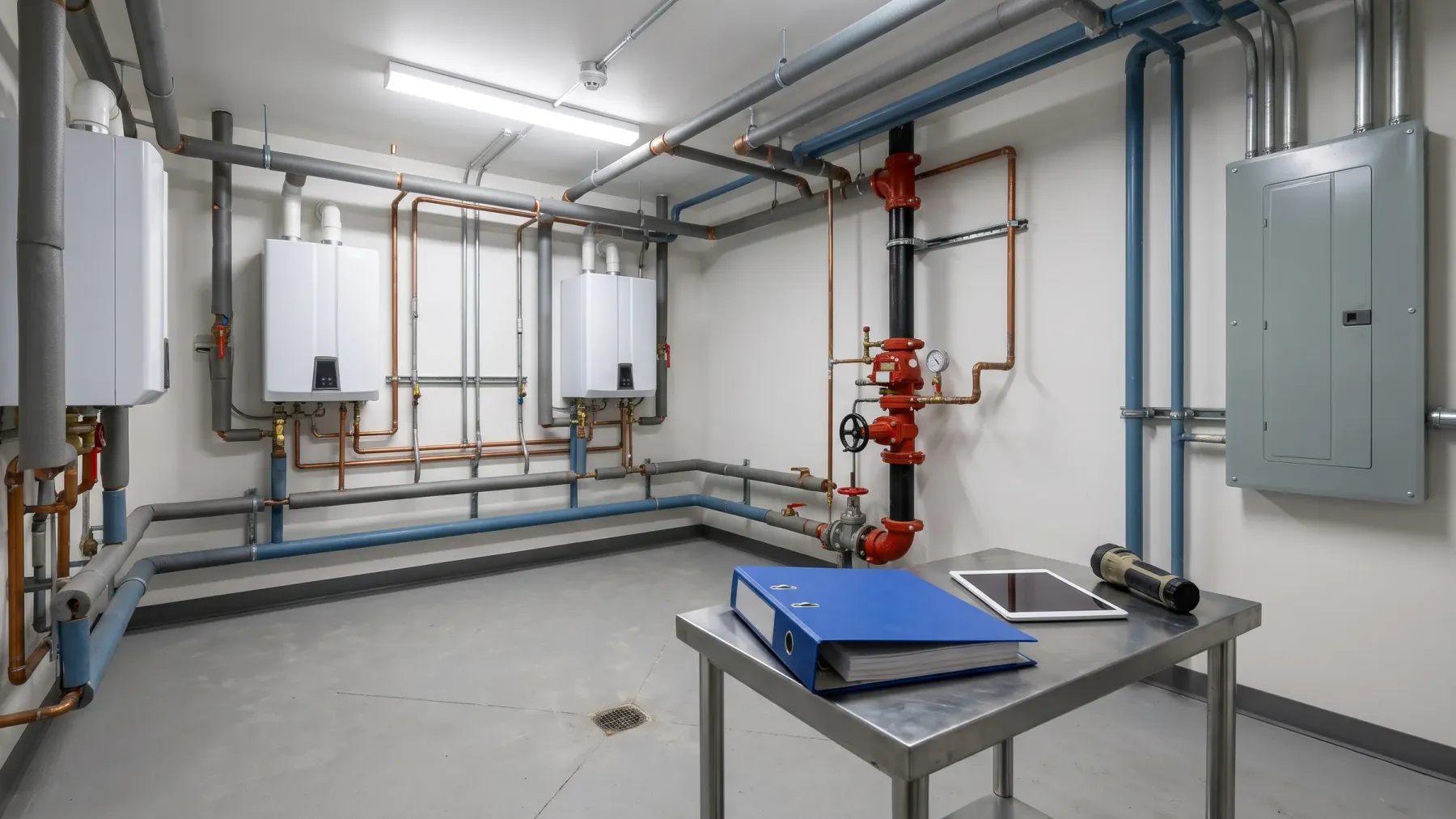
The log contains an inventory and a description of the common portions and of the materials, apparatus and equipment that compose them (section 2). It also covers those installed in the private portions whose maintenance is the association's responsibility.
That second group depends on the building. The guide published by the Société d'habitation du Québec (SHQ), the province's housing agency, gives smoke detectors, main pipes and water leak detectors as examples, and points out that the declaration of co-ownership is what determines the common and private portions. Have it at hand when the professional starts.
Seven items for each element
For each material, apparatus and piece of equipment in the inventory, the log must contain:
- the date of installation, if known;
- the required maintenance work, how often it must be carried out and the dates on which it was performed;
- ordinary repairs and the date on which they were carried out;
- the contracts for that maintenance work and those repairs, where applicable;
- the warranty contracts in force, where applicable;
- the reports of any inspections or expert opinions, where applicable;
- the manufacturer's maintenance manuals, where applicable.
Items 2 and 3 grow every year. Items 4 to 7 are documents: the log has to contain them, not just mention them.
A separate section: condition, remaining life and the next 25 years
In a section devoted exclusively to that purpose, the log estimates the condition and the remaining useful life of each element in the inventory (section 3). On that basis, it describes the major repairs and replacements to carry out on each one over at least the next 25 years, with an estimated year for each.
That section is the professional's work, and it is the starting point of the contingency fund study (section 8). The board does not redo it between reviews.
Major work completed
When a major repair or replacement is done, the log records its date of completion and its cost, and the documents relating to it, such as plans and specifications and contracts, are added (section 3, second paragraph).
What was not done, and why
If work required or planned in the log was not carried out, the log must say so and give the reasons (section 4, second paragraph). A deferral the board decided on belongs in the log, with its reason.
The annual update
Updating the log means adding any new information or document of the kinds listed in sections 2 and 3 (section 4). The professional who later reviews the log takes those updates into account (section 5). The SHQ's guide also recommends updating the log as soon as maintenance, a repair or a replacement is done, rather than once a year.
The template
Download the template (Excel, in English). It is free, needs no sign-up, and you can adapt it. A French edition is also available.
The template is not a maintenance log, and on its own it is not enough to comply with the regulation: it prepares and tracks the professional's work, it does not replace it.
It has one sheet per requirement of the regulation, each naming the section it comes from:
- Inventory (section 2): a number for each component, its description, location, common or private portion, installation date and where the manufacturer's manual is.
- Required maintenance and Maintenance done (section 2(2)): the work, how often, then each date it was performed.
- Ordinary repairs (section 2(3)).
- Contracts and warranties (section 2(4) and (5)), with the end date and the cancellation deadline.
- Inspections and reports (section 2(6)).
- 25-year plan (section 3): for copying in the professional's section, not for estimating it yourself.
- Major work done (section 3, second paragraph).
- Work not done (section 4): the work and the reason.
- Updates and reviews (sections 4 to 6): who updated or reviewed the log, and when.
How to use it:
- Before the professional's visit, gather what the association already has: plans and specifications, manuals, warranties, maintenance contracts, inspection reports, repair invoices, an earlier contingency fund study. List each component and where each document is. The professional starts from there instead of from nothing.
- Once you have the log, copy its 25-year section into the sheet provided, as written.
- Through the year, enter each maintenance visit, repair, contract and report as it happens.
- At the annual update, the board goes through the sheets, records any deferred work with its reason, and logs the update on the last sheet.
The file holds empty columns only: no made-up examples to delete.
Where a spreadsheet stops working
A spreadsheet is enough to start. It shows its limits as the log grows:
- Photos. A cell cannot hold the photo of the crack. Someone pastes a link to a folder, and the link breaks when the folder moves.
- Reminders. The file does not tell anyone that the roof drains are due for cleaning, or that the deadline to cancel a contract is next week.
- Several people. The janitor, the manager and three directors all write in it, and copies multiply by email.
- History. Nobody can tell who changed what, and when the board changes, the file sometimes leaves on a former director's laptop.
What Condo Inspection does
Condo Inspection does not prepare the maintenance log: the regulation reserves that work for qualified professionals. The application is for what falls to the association between two reviews:
- Start from the log you have. Upload your maintenance log or contingency fund study as a PDF. The application extracts the components, budgets and maintenance schedules, shows you what it found, and creates nothing until you validate.
- One record per component: identification, installation date, Uniformat code, remaining life, replacement date and cost, warranties and service contracts.
- The maintenance schedule: set the start date and frequency once, and the maintenance appears on the calendar and the dashboard by itself.
- Reminders before a contract renews and before the deadline to cancel it, and for upcoming replacements.
- Photos and video taken with a phone, attached to the visit or the component, and annotated.
- Deferrals explained: when a visit is canceled or postponed, the reason is recorded and stays in the history.
- The maintenance log report, generated from the data entered, as PDF, Excel or Word.
See how the component registry and maintenance log and maintenance scheduling work, or what the application does for self-managed buildings. Or book a demo and bring your maintenance log.
Sources
- Regulation establishing various rules concerning divided co-ownership, sections 1 to 6, 8 and 14, Gazette officielle du Québec, July 30, 2025, and its French text.
- An Act mainly to regulate building inspections and divided co-ownership […], S.Q. 2019, chapter 28, section 151: the deadline for existing associations.
- Société d'habitation du Québec, explanatory guide to the regulation (in French): the August 15, 2028 deadline, the examples of private-portion elements, and updating the log as work is done.
This article and the template are general information, not legal advice. For your building, talk to the professional preparing your maintenance log, your notary or your lawyer.